


On Becoming a writer

by Andrew J. Burton
About the Story Thing (2025) - 15
---------------
"About the Story Things" is a thematic series of articles, sponsored by Reality Skimming Press. Pieces in the series ran from Jun-Dec 2025. Query us about contributing to the Jan -Jun 2026 series at https://facebook.com/relskim or by email at info@realityskimming.com
---------------

The foundation of a desire to write.
Life experience, from my earliest memories, was a driving force, drawing me to pursue writing. My writing has taken many turns. Writing has served as exploration, as inquiry into the nature of life, reaching for an understanding of how things are, how life unfolds the way that it does, the search for meaning, for the “why” of things. These themes have driven my words through many years.
What was it all about? We all have our lives, or so we think. We are born, we grow, we interact with parent’s siblings, extended families, neighbours, the kid down the street that was the first of us to get a bike. John next door who held the memories better than I. The truth of a city rebuilding in the aftermath of war, growing up in a world where broken buildings bombed out shells of homes bulldozed to make room for returning veterans starting new families. Men steeped in the way of the gun, the Bren carrier, the drone of bombers overhead, killing, ending lives because it’s what you do, coming back to an unknown life.
The rebuilt city was a reality they never imagined. The new way of things, a warrior driving a city bus, ferrying fisherman from the docks to terrace houses down the end of Triton Road. Trawlermen dragging the North Sea for cod, halibut and sole where short years before they hunted U-boats in flower-class corvettes. They came together, “veterans” they called themselves, brought down by the weight of memories too hard to wash away. War defined their lives by the age of 26. They drank too much, fought worthless battles in the street, pushing back against nightmares of Africa, Sicily, the western shores of France, liberating Belsen. So much blood and pain, but now it’s over. Best to let it go. No sense in dwelling on the past. The unspoken message; “You have a family now, so put the war away. Be done with it and raise your children well.”
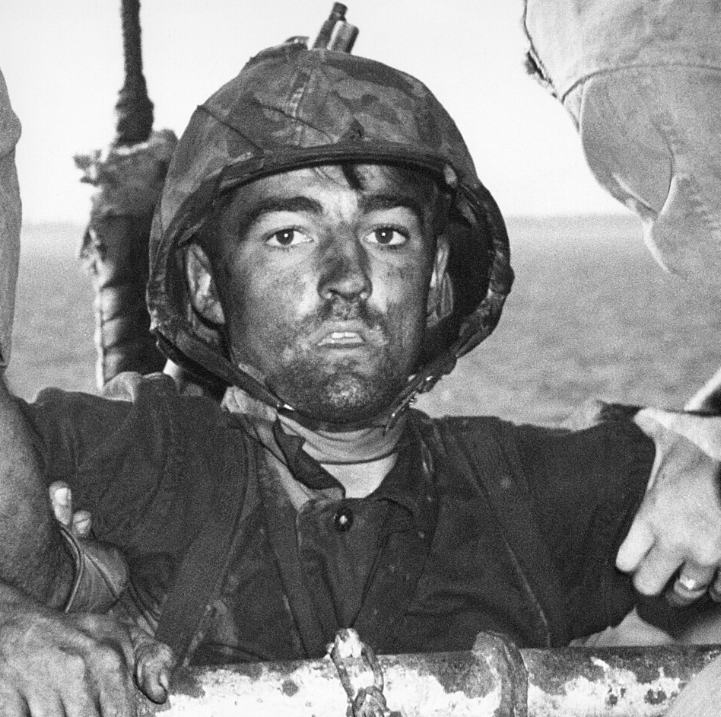
He tried, God bless him. He really did, but the dreams would not let go. He saw their faces; young men like himself in different uniforms. He felt their bodies shake as their souls let go, pulling their heads back pressing down between the collar bones with that Fairbairn dagger. The way they were taught, to kill without a sound, to raise no alarm, then set the charges to blow the ammunition, fire a fuel dump, strike fear in a sleeping Afrika Korps, then slip away across the dunes to the east.
This was the world his children were born into. “Post-war” they called it, as if it was a normal thing, a simple thing, as if it was all done with, all over. Twelve years after the war’s end, we moved to Canada. It should have been the new beginning he was after, but it didn’t take. Echoes of the past remained, rising and falling like the tide. He settled the family in Winnipeg, hoping for a better life. The ghosts were close behind.
At twelve my father taught me the way of the knife, the dagger behind the collar bone, the silent death. “There’ll be another war”, he said, his voice calm and quiet; “you’ll need to know this.”
I remember thinking; “I’m twelve! This can’t be right!” I did not speak, but I remembered. Two lessons I would never forget. One was to stay frosty around him, to be always on guard. The other was, the knife.
Well; It’s been sixty years, I still remember how. Thanks be to God I’ve never felt the need to use it.
Coming to terms with my young life, I disappeared into books living vicariously through science fiction. I began to write while very young. I remember in 1964 my father asking me; “What do you want to do when you grow up?” I didn’t want to answer. I was always cautious, never sure what was safe to say; “I want to be a writer”; I finally said; “Like Isaac Asimov!” He turned and walked away, stopped, then spun around, took a step toward me. I remember thinking he was going to hit me, but he stopped: “Don’t be a bloody fool”; he said. “You’ll never make a living as a writer. You’re not smart enough for one thing. Learn a trade, something that’ll pay the bills.” He stood silent for a moment, then turned and went back into the house. We never spoke of it again. I hid away the stories I had started. I did not write again for many years. As soon as I was able, I left home, living on the street until I could find a place that would rent to someone under age, no questions asked.
Our experiences of life, all of them, shape our thoughts, our feelings, our ways of being, forging the basis for who we will become. They also, quietly and persistently, provide “grist for the mill”, guiding and shaping what and how we choose to write.
For a long time, the desire to write haunted me, often at war with my father’s words. I would write things, put them away and move on, sometimes feeling guilty, as if just writing a poem or a story was somehow a betrayal of the old man, of the family. From time to time, I would send something off. Occasionally I would have something published. I went down a lot of roads, looking for a “straight job” I took on a lot of different roles, tended bar, trained as a chef, worked remote jobsite construction in the arctic, took acting classes, worked on movie sets, whatever work came up.
A turning point was being unemployed in Churchill, Manitoba. It was late fall and I was living in a run-down trailer next to the cemetery, a hundred yards from Hudson Bay. Christmas was coming. I was living on KD and Ramen. The cold was settling in and I did not have enough stove oil to last the winter. I heard an announcement on CBC radio. They were having a poetry contest. Write a children’s poem inspired by “Twas the Night Before Christmas”. There was a cash prize. I sat down at the table and wrote “The Littlest Polar Bear” a poem about a bear cub that saves Christmas. I submitted it to the CBC and won the contest. They sent me a cheque and had an actor from Toronto read the poem over CBC World Service on Christmas eve. I began entering poetry contests whenever I could and started to get a track record. I got a call from a publisher in England. They had heard “The Littlest Polar Bear” on the radio and were looking for poems for a magazine for parents of young children. By that time, I had sold a murder mystery short story and some “death poems” to Ellery Queen. I was immersed in a dark world of murder and mayhem. So, naturally, I began writing “Horror Stories for Children”, highlighting all the monsters that had had scarred my own childhood in poetic form.
Other opportunities came along but not enough to pay the bills. I found work to make ends meet, and went back to school. I took a range of courses got some certification and became a social worker. I signed up for a BSW program through the University of Manitoba. My writing began to change. I wrote a lot of non-fiction, academic papers, grant proposals, program manuals, and some research pieces. I got a few things published. For a while fiction and poetry began to take a back seat again. Then they would surface and I would dive in once more. I became involve in the theatre world, started “The Street Spirits Theatre Company”, a repertory company for youth, producing and performing original plays about problems in the world. We toured frequently for many years. My writing became scripts for stage and screen, along with papers on performance and activism. In theatre, we travelled in Canada and the United States with original plays created by the members of the company. I wrote and directed many plays and several films. Occasionally poetry and fiction would make a comeback.
Now here I am, writing a post on the process of writing. The things I’ve learned along the way. There are, I think, many things that still remain for me to learn, but I do have experience and a life to share. Stories I have picked up. Wisdom passed on by people I have encountered along the way.
Meaning and motivation from the words of others
My father’s words. “Learn a trade;” messed me up for a long time. But looking back, beyond the hurt, there was a shred of truth to it. Consider this; it’s hard to make a go of it as a writer and Ramen as a steady diet gets old real fast. Having skills to keep you going is a good thing. Education takes you to new ways of thinking, understanding, means of communicating, as well as skills that prove their worth whatever future paths you tread. Any course you take broadens your horizons and will make you a better writer. (You may not realize it right away.)
Di Brandt (Manitoba Poet Laureate, my mentor in poetry in 1988) Her words to me; “There already is a Robert Service.” Some of my early poetry was strongly influenced by Robert Service. I was living and working in remote, wilderness areas and two of the three books of poetry in the Churchill Public Library were by Service. The point Di was making was; “Find your own voice.” To really write something worth reading, you most be real and honest in what you say and how you say it. Anything less is not you. Your readers will know it and close the book.
Denis Cooley (Poet, Professor at University of Winnipeg) Denis told me; “Follow your vernacular muse” There is a tendency, especially if you have studied at a university, to write in a formal way, within strict rules of grammar. People don’t talk like that. Many people’s spoken language is messy, unkept and idiosyncratic. So, write that way, okay? Jesus H Christ! Ya think anybody’s gonna buy a street rat character that don’t talk like one?!
Wes Charter (Metis Elder) His words to me- “. We come to this world with nothing. We leave with nothing. All we have is our time. You chose to spend this time with me and I thank you for that.” Wes reminded me that time with people matters. For writers it can be wonderful to connect with others. We can learn and find inspiration in a conversation, a collaboration, a shared experience.
Robert Bly (Poet and writer from Minneapolis) Robert said; “You can’t write anything in your own room) If you almost always write in the same place, you run the risk of drying up, of repeating yourself, getting lost in the same tone and cadence. Get out in the world, go for coffee, ride a bike, paddle a canoe, take pictures, draw, paint, make things out of clay. You will find new ideas, new perspectives and inspiration.
Nathaniel Branden (Psychologist and writer) I met Nathaniel in 1989 and attended a retreat with him. In one conversation he said; “Lies do not work.” For a writer this can be an important lesson. A character in a story can tell a lie “, in character”, and it can compel the plot forward. It works because that character is speaking to another character. If an element of a story lies to the reader, that reader will, on some level, resent it. It becomes a “stop moment” in the story, disrupting the flow for the reader.
Beyond that, as a writer, one can easily fall into the trap of lying to one’s self. (“The deadline is Tuesday; I’ve got lots of time.”) NO, YOU DON’T! and you know it. Lying to yourself can seem easy. There is always a cost. Even if no one else knows, you do and you will pay a price, your writing will pay a price. Make a commitment to taking responsibility for the choices you make.
Things that I have found useful
Read (a lot) Reading makes you aware of how other writers reach their audience, how they use literary devices, build plot structure, manage subplots, develop characters. Analyze stories to identify what makes them compelling, what draws people in. If you don’t like a particular story, ask yourself what it is that turns you off. How did the writer miss their mark? Or, what is it about the story that rubs you the wrong way? (Remember, somebody thought enough of it to accept it for publication!)

Read Literary magazines. For the most part, Literary magazines publish work that is well written, creative and distinctive in style. (Some do get “lost in the trendy” from time to time) Respected Literary magazines can open up new ways of writing for would-be-writers, and can help to improve or fine-tune your work. (Note*- Many well-known Literary magazines have very high standards and receive a great many submissions. Getting a rejection letter from one of them is to be expected. Don’t take it to heart. Learn from it. If you get an acceptance, celebrate!)
Write poetry. It is a fantasy that you will get rich and famous from your poetry. (It is possible to get somewhere writing song lyrics, but it’s still a longshot. For every Bernie Taupin there are a multitude of unsung dreamers). However, writing poetry teaches you form and style. It teaches you to create prose that connects with people and asks readers to find the unspoken meaning within the piece. Incorporating poetic forms in writing makes the reader a part of the creative process rather than a passive observer. Do it right and they will come back for more.
Buy some notebooks. Get in the habit of carrying a notebook with you. Buy ones that are easy to write in and easy to carry. (Do not buy expensive or fancy notebooks! You will resist using in them because “you don’t want to waste them or mess them up with sloppy writing”).
Get out of the house Go places and do things. From time to time, you will see something, hear something, feel something, that sticks in your mind, sparks your imagination. Write it down! (Remember the notebooks?) I have written a lot of stories and poems inspired by moments, riding a bike, paddling a canoe, drinking coffee in a roadside diner.
Join a writer’s group. I belong to several writer’s groups, some online, some in person, some with regular meetings, some sparsely scheduled. Writing can be a lonely and solitary practice. It is helpful and it can feel good to connect with others in “common cause”.
Take lessons. There are always opportunities to learn. I have taken a number of short courses and “one-off” events that have helped me to improve as a writer and have inspired me to write more. There are some free ones out there and some that charge a fee. (From my own experience, I recommend “Find Your Flow” (drop-in sessions) and “Our Stories Our Voices” (courses) Preeti Dhaliwal leads these regular poetry drop-in sessions and courses. (There are fees for these) Her offerings can be found at www.eventbrite.ca .)
Perform. Seek out open mike opportunities. If you find one that works for you, attend and take part regularly. Reading or performing helps you to get a sense of what people appreciate and are touched by. It can help to develop public awareness of you and your work. It also stimulates you to write more.
Create a Social Media presence. Put yourself and your work out there on social media. Facebook, Instagram, YouTube, Substack, TikTok, can all help you to develop a presence and to build some name recognition. They can also be a source of feedback and inspiration.
Support other writers. First off, don’t think of other writers as competition! Encourage other writers, share opportunities, read their work, buy copies of things they get in print. Give feedback if asked but be sure what you offer is supportive and useful. If you like what they wrote, say so! If you didn’t like it do not say that you did! They will not trust what you say in future. Ask questions! “Are you happy with your story, poem, rant, etc.?” “Is there something you’d like to change about it?” “What has worked really well for you?” If you have the opportunity to teach, do it. “A rising tide lifts all boats”. Your knowledge may help others and, in the process of teaching, you deepen your own skills, awareness and understanding.
Don’t turn things down. If you are asked to perform, present, write something, DO IT. Opportunities that come along help you to build a reputation, and to have your work recognized. I have been asked to speak at events, to write copy for businesses and to write poems (and songs!) for groups and organizations. It can feel really good to have someone approach you and say; “You’re that poet! I saw you at the Awards ceremony!”
Submit. Get in the habit of sending your work out to magazines and publishers. Yes, you will get rejections. Steven King collected a lot of rejection letters before “Carrie” hit. Keep going! Submit to a range of publications, including online opportunities. Read those rejection letters. A lot of them are boilerplate but some editors will give you ideas and directions to follow.
Don’t quit your day job! Writing can be a precarious way to make a living. There can be times when your work is selling, when opportunities present themselves to do more. Don’t count on it to always be that way. There may also be long periods of time when you are not making an income from your words. There is value in having predictability and stability in your life.
Good Luck and Good words!
---------------
Andrew Burton is a Canada-based poet, playwright, and creative arts social worker, resident in Prince George, British Columbia, since the mid-1990s. He founded and served for many years as Artistic Director of Street Spirits Theatre, a socially-engaged theatre company that received a citation from Canada's Solicitor General, the Queen Elizabeth II Diamond Jubilee Medal and the Otto Award. An award-winning writer across genres: poetry, short stories, articles, and plays, Burton has appeared in literary outlets such as Ellery Queen, Minstrel, Dreamland, CaNon, Dateline Arts, Parent Connection, Thimbleberry, and Biker magazines.
---------------
Image Credits
Marine after Eniwetok assault. (1944, February). United States Marine Corps Private Theodore James Miller is pulled aboard a Coast Guard transport after returning from battle on Eniwetok, 1944 [Photograph]. Wikipedia. https://en.wikipedia.org/wiki/File:Marine_after_Eniwetok_assault.jpg

Mình hay xem soi cầu XSMB với soi cầu MB mỗi ngày để kịp cập nhật trước lúc quay số, kiểu để đỡ bị động. Thường mình cũng lướt qua phần dự đoán XSMB, xem thêm thống kê lô gan và lô xiên để tự cân nhắc xem dạo này bộ số nào có dấu hiệu lặp lại. Có hôm anh em trong nhóm còn bàn về mấy công cụ quay thử XSMB, Rồng Bạch Kim, rồi đối chiếu dữ liệu lịch sử cho dễ hình dung tần suất thực tế. Mình thấy dd xsmb chỉ là một phần tham khảo thôi, chứ đoán miền Bắc không thể trông vào hên xui hoàn toàn, vẫn phải ghép thêm cầu bạch…
Mình mua vé số chủ yếu cho vui, coi như một kiểu giải trí nhẹ nhàng nên cũng không đặt nặng chuyện phải trúng to. Trước đây nghe người ta bàn về “cầu kèo” các kiểu mình thấy hơi mơ hồ, nửa tin nửa ngờ, nhưng theo dõi lâu thì cũng có lúc thấy vài dạng số lặp lại làm mình chú ý. Mỗi lần đọc dự đoán ở đâu đó, mình thường ghi lại vài ý rồi vài hôm sau lôi ra so lại, để xem có phải mình đang tự ám thị không. Dạo này thỉnh thoảng mình ghé https://soicauxsmb.io/soi-cau-giai-dac-biet.html để nhìn thêm một góc khác, nhưng vẫn tự nhắc chỉ nên xem tham khảo. Có hôm trúng…