


Libraries, Nurse Logs, and Goats

Updated: May 19
by Holly Schofield
Things About Governance (2026) - 09
---------------
"Things About Governance" is a thematic series of articles, sponsored by Reality Skimming Press. Pieces in the series run from Jan-June 2026. Query us about contributing for $25 CAD a post at https://facebook.com/relskim or by email at info@realityskimming.com
---------------
Growing up in Toronto, my local public library actively prevented me from reading. By age eleven, I'd read every single book in the children's section and was under-age to enter the adult room. So, I'd hover just inside the door, shifting from foot to foot at the magazine rack, reading science fiction magazines like Analog and F&SF until stern librarians chased me away.
When I could finally enter as a card-carrying 12-year-old, I devoured all the SFF anthologies, including those with alternative forms of government such as Joanna Russ's "When it Changed", E.F. Russell's "And Then There were None", Suzette Haden Elgin's Native Tongue series, and memorably, Tanith Lee's sardonic voice, telling me that everyone has a place, even if that place is not mainstream society—all of that helped guide me to how I now live and what I now write.
It was always my goal to write SFF short stories as soon as I had the time to do so. Novel-writing is not something I’m terribly interested in and, as I say in a SFWA blog post, I don’t see it as a necessary step in an author’s career. In the past 12 years, I've had over one hundred short stories published in venues like Analog, Lightspeed, Year’s Bests, and many anthologies, and I've been an editor and writing mentor. In all of these ongoing adventures, SFF’s legacy is steering my hand.
The SFF I read the first few decades of my life (all that was available at that long-ago public library) almost exclusively featured American settings and confident, extroverted, able-bodied white American males with structurally embedded advantages singlehandedly saving the day. That… gets tedious. Like many writers these days, I want to go beyond those tropes and viewpoints, and examine other types of characters in other settings and cultures. I’m thrilled that, these days, SFF is in a welcome evolutionary stage of being identity-forward, not plot-forward.
Post-capitalism, live long and prosper
I’ve often wondered why Spock’s Vulcan phrase included the word “prosper”. Surely it isn’t meant to become wealthy in the resource-extractive in the way we are now, to become individually rich in the way none of the Enterprise’s crew are. It’s got to be referring to the evolution of our concept of “wealth” and of collective prosperity. As Robert Runte said in The Ottawa Review of Books:
Star Trek’s progressivist future told us, “you’re fine the way you are, it’s society that needs to grow up and accept you for who you are”. … Star Trek has significance in providing both positive role models and an escape from cruel reality. … Star Trek’s values influenced generations of kids to become stronger, kinder, better people.
Other influences on my sense of “what comes next” are many and varied. Choosing to be governed by only some of the ways imposed upon us is another legitimate response to whatever culture or government we are born into. Thoreau’s Walden Pond has always intrigued me, the concept of a hermit living away from society. If society doesn’t fit a person, then do they need society? Despite the many recent criticisms of Thoreau’s and his hypocrisy (some of them in error), his work is still an important examination of an alternative way to live. In fact, his famous watermelon parties show that he did interact with people in ways that benefited his own wellbeing and meshed with societal expectations.
Of course, Thoreau was all about civil disobedience. The less government the better, and resistance where needed. He lived in a society and under governance that had arguably fewer rules and restrictions than our own, and certainly contained less complexity. So how can governance be simplified and made more efficient?
The Benevolence of the Dictator
A kind and intelligent ruler seems like an efficient way to go. Can this form of government truly work or is it wishful thinking? Alexander the Great, Al-Ma'mun, Suleiman the Magnificent, all flawed in various ways—we really don’t have a solid real world example, and, eventually, hegemony is gonna hegamony.
I examine this concept in my story, “The Call of the Wold”, first published in World Weaver Press’ Glass and Gardens Solarpunk Summers, which garnered several nice reviews:
"This anthology is a welcome relief from dystopias and postapocalyptic wastelands, and a reassurance that the future need not be relentlessly bleak."
—Publishers Weekly
"Each of these stories is a window into a world where issues like climate change and food shortages are approached with a joyful creativity. The variety in character, narrative approach, and setting offers something to appeal to a wide variety of readers, especially those who look to anthologies to find new authors to follow."
—Booklist
Via the very fun use of malaphors (well, I think they’re fun but they’re an acclimated taste, they do make some people “lose their bananas”), an introvert finds herself in an intentional community run by a benevolent (but not always competent) dictator. As Julie, the main character might say, by entering the community, she’s “opened a can of worms and now must lie in it”. The first conflict is over the ownership of a guinea fowl:
"Tell me, what do this collective's rules say about ownership of the bird?" I squinted, trying to see Aaron through the growing dimness.
"Ownership isn't the issue. I actually own it all," Aaron said.
"Wowsy," I said.
He leaned forward in to the light. "My mom, Helen Henkel—"
Everyone made a slow fist of respect.
"—most decent person I ever knew."
"—peace be upon her."
"—she never phoned it in."
Ah, that explained Aaron's clumsy handling of the incident at the gate. The mantle of leadership was XXL and he was an extra-small. He muttered, "Mom set this place up as a formal trust—everyone signed over their assets to her in return for lifetime rights to live here."
"And that worked? A dictator telling you folks what to do?" My voice squawked like the poor guinea fowl. I'd see that style of intentional community before—usually the people had a fundamentalist religious doctrine or another form of abhorrent behavior. Or a commercial agenda, like when marijuana went legal. Some of those communities made a small fortune—by starting out with a large fortune.
They were all smiling at my naiveté, or maybe I had spinach in my teeth.
Aaron spoke from the depths of his hoodie. "A benevolent dictator is actually the best form of government. If you can find the right person." He scrubbed his face with a hand. "Trouble is, I'm not the person Mom was."
Reviewers called this a “standout” story and “enjoyable… with an appealing main character”, but more importantly it seems to make people think. Given human nature, I still wonder, is good governance in this form really possible?
AI as a governing body, really?
If human nature is what it is and unlikely to evolve quickly, how about using AI? Could a logical, impartial machine intelligence govern us better than humans have managed so far?
Science fiction, as a whole, evolves in sync with the zeitgeist of the times. SF writers are all “having a conversation”, as John Clute, the SF critic, has said. With feminism being a main theme in the ‘70s through to today, along with increased focus on gender diversity and neurodiversity, and with climate change now influencing anything and everything, into the mix has dropped AI and its related outcomes. Can AI serve as a benevolent dictatorship? Is it possible? I doubt that it is, but I examined the concept anyway in a story called “One Bad Apple” in SciFuture’s The City of the Future, and reprinted in No Police – Know Future which is an anthology of stories about the future of policing and justice. Editor James Beamon was seeking “alternate concepts of rehabilitation and punishment <with> more emphasis on the carrot. In a world where police are perpetually brandishing their batons, I think we’ve all seen enough sticks… ” and I responded to his call. As an extremely private person, I started out to show that extreme government surveillance is wrong-with-a-capital-W and the only way to combat it is to go underground (and to have personal sousveillance). But, as I revised the story multiple times, it morphed, as stories tend to do—and, no kidding, the logistics of having an environmentally conscientious municipal government were SO much better when surveillance was increased. For example, today we have about 30% wastage in the fruit industry—in the story, there are food crops adjacent to every roadway and sidewalk, planted and maintained by the city, free to everyone. The city AI knows when each individual apple ripens and it makes sure it gets picked that day and that it gets into the hands of the most needy. And, yet, the story leaves most people with an uneasy feeling… as it should. The potential for human abuse of power is certainly high enough in a totally surveilled community, whether it comes from a high-up administrator or a low-level IT worker. On the other hand, if people are living their best lives, then maybe they don't need to engage in that sort of abuse of power? I continue to think about it and examine other ways to govern...
Solarpunk: More than Solar Panels and Goats
I started out writing fiction about anything and everything, finding my feet and my wings. I wrote dystopian stories because that was what I’d been reading my whole life. But then I realized SFF doesn’t have to be that way. As I said in a SFWA blog post about optimistic fiction:
Dystopian fiction seems to be built into the human psyche. Is it our default setting, or can we transform our collective narrative into a higher philosophy, a better way of thinking? These past couple of years of near-dystopia need to be overcome—as Spider Robinson says: let’s refute entropy.
Nowadays, I usually write about inclusivity or environmental concerns. Whether my story is delineating where we go wrong in dealing with other people or how we are methodically ruining the planet, both topics usually run up against governance. Especially favorite topics of mine: solarpunk, eco-fiction, and climate fiction.
Solarpunk overlaps with eco-fiction and climate fiction but isn’t quite the same. Eco-fiction has the setting as a character; the natural world is part of the story. Just as a story is not science fiction if the science element can be removed and leave the plot intact, the equivalent is true for eco-fiction: if it can take place in a bland artificial setting, it has not met the definition.
Climate fiction (cli-fi) takes that one step further and is an examination of how humans affect the world around them—the good, bad, and ugly of it all. In the SFF world, when writing about the future, cli-fi is now the only genre possible.
Solarpunk has been mislabeled as nothing but “solar panels and goats”, but it’s really much more than that: a blend of eco-fiction and hopepunk. The “punk” part simply means pushback against the parts of the status quo that aren’t working. And, of course, optimism itself is a form of resistance. Again quoting from my SFWA blog post:
Hopepunk was coined by Alex Rowland in 2017 as the antithesis of grimdark and dystopian fiction. It embodies the aesthetic of positivity and spans the broad spectrum of speculative fiction—yes, even horror. It’s a bandwagon whose time has come. As @AbrahamHanover tweeted, “In an age of performative cruelty, kindness is punk. Be as punk as f*ck.”
And
… Derived from the trenchcoated-and-mirrorshades cyberpunk subgenre, solarpunk emphasizes environmental concerns, as well as Afrofuturism, Amazofuturism, and other resistance movements. In these stories, BIPOC, queer, disabled, neurodivergent, and other marginalized communities flourish and evolve into utopic scenarios. Recent articles from YES! Magazine, the BBC, and Vice attest to the new wave of sunshine spreading across all media.
My intersectional cyberpunk/solarpunk story, “The Robot Whisperer” is available to read or listen to on Escape Pod.
My blog post continues:
The solarpunk wave is happening in our own fertile SFF fields. Grist’s first Fix solarpunk contest attracted 1,100+ entries. Reckoning magazine started in 2016 and is going strong. Most major established SFF magazines have published Technogaianism stories in 2021, and new online publication Solarpunk Magazine‘s recent Kickstarter has been wildly successful. As writers know, if you build a market, writers and readers will come.
Humanity has a very difficult task ahead, to pull back from the brink, and fiction can instill the radical optimism that is needed. That's one of the reasons I volunteered to be a fiction co-editor at Solarpunk Magazine when it first started in 2021. And why I wrote “Hearsay”, a story about a way to actually change human nature for the better (reprinted in The Year's Best Canadian Fantasy and Science Fiction Volume Three). There’s nothing more radical or difficult to cultivate in these times than a vision of hope.
Rational hope—defined on my blog as something that “allows for increased agency, for a belief that it is possible to affect the situation“—isn’t always easy. Sometimes you just have to despair and mourn for a bit. My story, “A Distant Honk,” a rather odd story about the demise of feral clowns, is a combination of climate grief, guilt, and despair.
Collectives, communes, found families, and intentional communities are one approach to governance that has not been revisited much in the modern era but is having a resurgence. As SFF evolves, we are moving beyond the “lone hero” trope and seeking communal problem-solving methods that actually work, as noted by Ada Palmer and Jo Walton’s essay “The Protagonist Problem” in Uncanny Magazine. When a writer worldbuilds a community that is collectively and cohesively working toward inclusivity, resilience, and sustainability, they can turn their voice into a force for change.
In a raincoast forest, there are nurse logs: mossy fallen tree trunks which, as they decay, provide holistic support to the localized ecosystem. Just hard science fiction acts as a catalyst, sparking ideas like one of Nic Tesla's towers, solarpunk acts more organically like a nurse log helping to grow and nurture thoughts of a better world.
So, I continue to write solarpunk. Whether my story is about insects who print resistance literature in “The Scent that Treason Brings” (a Cast of Wonders Staff Pick!) or about an intentional post-capitalist community such as a commune in the Rockies (the setting for “Halp’s Promise” which appeared in Glass and Gardens: Solarpunk Winters), I try to show new pathways to follow, new paradigms to contemplate, and perhaps new narratives to incorporate into our future.
After all, the future is all we have.
So What’s Next?
I see science fiction having a sort of “push me-pull you effect”. Remember the two-headed Pushmi-Pullyu in the Dr. Dolittle books? The gazelle/unicorn (or llama in the movies) tries to go in two directions at once. Science fiction pulls the world forward in a multitude of possible futures, and it’s also pushed by society to explore a vast array of new territory.
While SFF isn’t necessarily predictive, it has sometimes been so; examples abound, from the TV to landing on the moon to the cell phone to cloning. These days SFF generally used to explore two overlapping things, the effect on our psyches because of technology, and, more frequently, ethics. Current SFF is examining brain implants, AI, food gene-editing, extreme warfare, geoengineering, and more. And I think it helps us as a society. If we can study these topics using SFF as the litmus paper and vicariously experience all the desirable and undesirable outcomes via literary immersion, we can know how to address these developments when the time comes. In addition, it become the norm. Star Trek’s sense of justice and equality and post-scarcity economy are now part of our collective envisioning of the future. Birth control and feminism came a long way when people really thought about the ramifications, and Tiptree, Russ, and other SFF feminists were a part of those early stages of the acceptance of what is now is a commonplace item in most areas of the world.
To me, just as a writer cannot revise a blank page, so we—the collective “we” of humanity—cannot visualize a utopic future without first imagining its various possibilities strewn across the blank canvas of the future.
It’s up to SFF writers to create that meaningful space so that the eleven-year-olds of today can wander through a library and visualize their own incredible futures.
-------
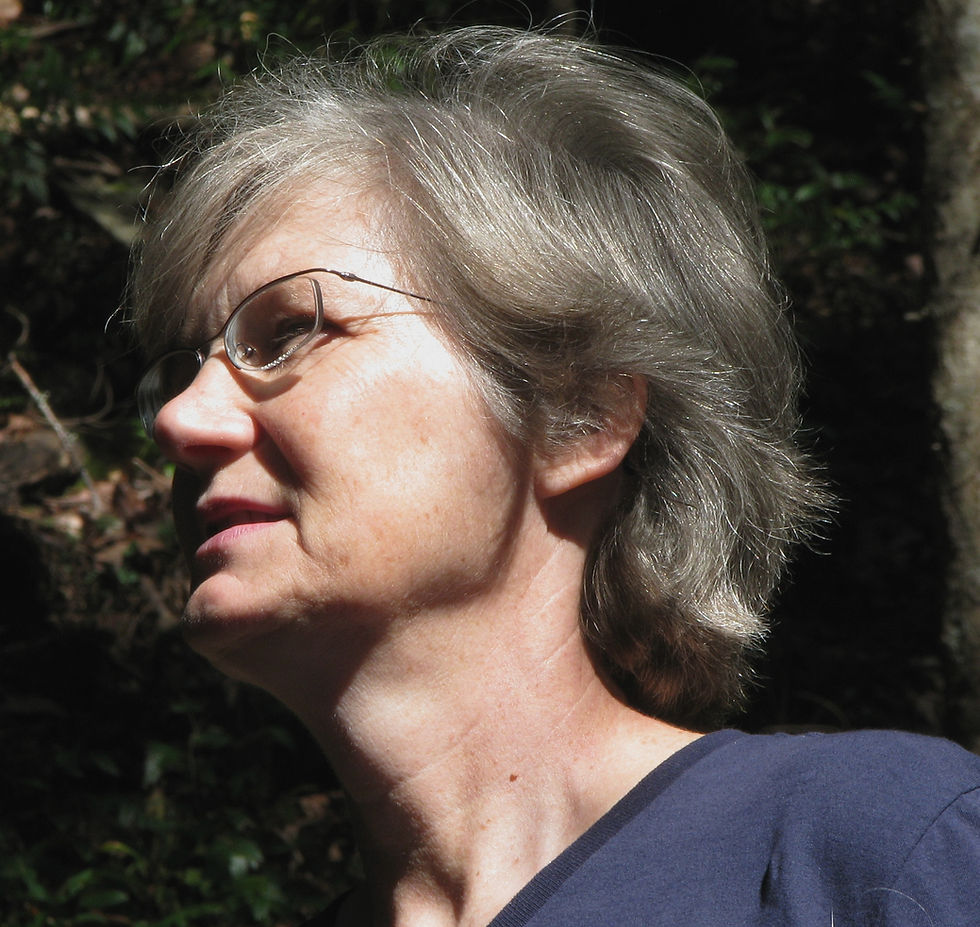
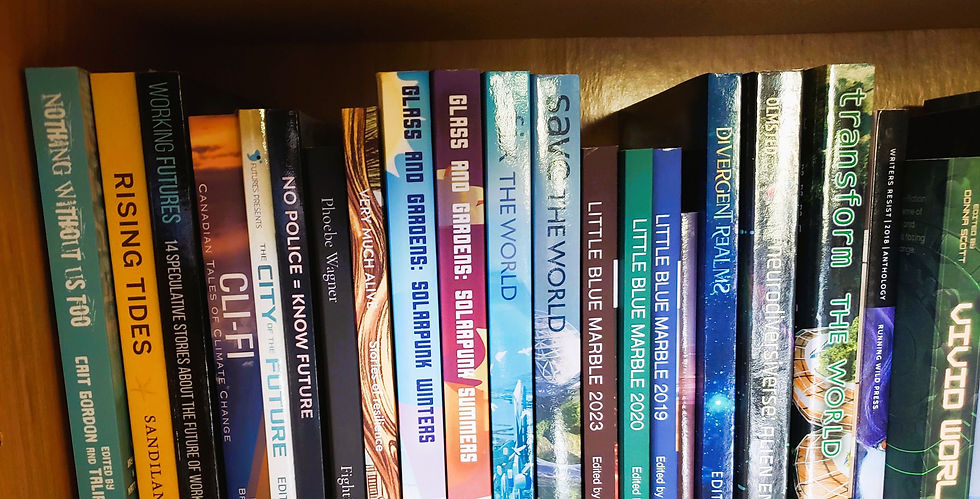
Holly Schofield (she/her) is the author of over 100 speculative short stories in genres ranging from hard science fiction to magical realism. Her focus is on environmentalism and inclusivity. Her ecofiction has appeared in Rising Tides, Glass and Gardens: Solarpunk Summers, Glass and Gardens: Solarpunk Winters, Cli-Fi: Canadian Tales of Climate Change, Little Blue Marble, Future Fiction, Fighting for the Future, and many others. Her works have also been published in Analog, Lightspeed, the Aurora-winning Second Contacts, the Aurora-winning Nothing Without Us Too, Tesseracts, and many other publications throughout the world. Her fiction is used in university curricula and has been translated into multiple languages. She has been a fiction editor at Solarpunk Magazine, has mentored new writers, and is a juror for writing grants. Find her at hollyschofield.wordpress.com.

Comments