


Holly SchofielD On Sustainability

Updated: Mar 19
hosted by Nina Munteanu
Mar 17, 2026 - 04
---------------
The Sustainability thread is a thematic series of articles, curated by Canadian SF author Nina Munteanu and sponsored by Reality Skimming Press. Pieces in the series appear twice a month. Query Nina Munteanu about appearing on the thread at nina.sfgirl@gmail.com
---------------
Interview with Author Holly Schofield on Sustainability.
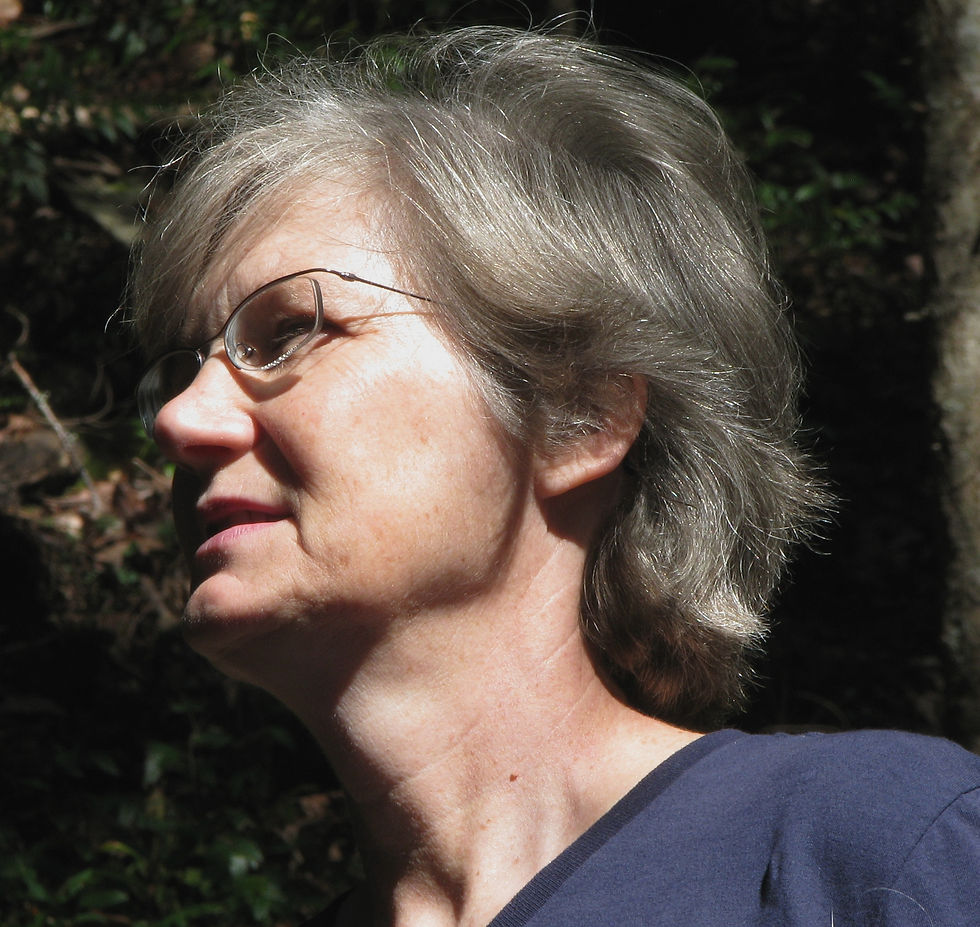
My guest today is Canadian speculative fiction author Holly Schofield. Her short stories have a focus on inclusivity and eco-fiction, with a special interest in solarpunk. Her worlds, set on futuristic Earths and on exoplanets, have explored many potential models of sustainability and what human ambition means to the challenges we impose on various ecosystems. She’s had stories in many magazines and anthologies, including the Water anthology edited by me and published by Reality Skimming Press.
Nina: · How would you define sustainability and what do you consider the key components to be sustained?
Holly: Sustainability means taking the long view and the big picture view. The idea that sustainable crop management within a single farm or sustainable forestry within a single valley are meeting some sort of “sustainability” goal is a resource-extractive mindset that has to change. If we don’t have global sustainability, then the world continues to be on a downward slide. The systemic destruction humanity is currently responsible for is going to require our collective attention for a long time to come. And it starts with a changed worldview that includes people as part of nature, not separate from it. To paraphrase the increasingly relevant quotation by Walt Kelly’s Pogo, which is “we have met the enemy and he is us”: We are nature and nature is us. Until that mental shift occurs, even multinational projects of emissions reduction, geoengineering, or reforestation are going to lead nowhere.
Nina: What does the phrase of our thread title “Sustainability Before Ambition” mean to you and how does it affect you: how you live, what you write?
Holly: Three things combine to largely form my mindset of living a sustainable life. My mother taught me ‘waste not, want not”, a legacy from her Depression-era childhood but one that became ingrained in me. As well, in 1988, I was part of the first blue box recycling program offered by the city of Edmonton (the most extensive of its kind in Canada and second largest in North America at the time); it was then I first heard the term “reduce, reuse, recycle,” and took it to heart. Thirdly, as a financial professional during my working life, I often counselled people to “live below their means”. The concept of not being defined as a consumer, of living with a light footprint, and of not spending all that you could spend are one and the same. It’s part of a mindset of sustainability that I’m still working on and which humanity clearly needs to tackle. Nowadays, I grow most of my own vegetables, seldom buy clothes (and buy second-hand if so), don’t travel much, and carry a bag to pick up garbage when going for a walk on the shoreline near my home. I also volunteer at a local nature conservancy and a local library. This is not a humblebrag; in a sense, it’s selfish because it makes me feel good about my actions, much more so than having the latest tech gadget or sweater. If only everyone felt the same.
Nina: In your community, what do you see as the major barriers and facilitators of sustainable living? What do you think are the major barriers and facilitators for organizations and nations?
Holly: Governments are made up of people. Local politicians, local business owners, CEOs of multinational corporations, and world leaders all need clean air, water, and food, just like the rest of us. However, they aren’t seeing the reality of what’s happening and they likely won’t until it affects them in a larger way. Crop failures on larger scales, horrendous storms hitting wealthy enclaves, heat domes that overwhelm a billionaire’s infrastructure—incidents like these need to happen within the circles that these folks operate in and start to affect their daily life. Only when we reach that point will real change occur.
That doesn’t mean we don’t keep trying to do what we can. Grassroots movements, living lightly, and cultivating an “I’m part of nature, even as I actively steward it” approach all contribute to our global ecosystem sustainability in their own way.
Nina: What is your opinion of the Sustainable Development Goals set out as part of the 2030 Agenda for Sustainable Development by world leaders at a UN Summit in 2015.
Holly: Although the UN 2015 goals—and those of subsequent global attempts, including COP30 in November 2025—didn’t yield the response I’d hoped for, there are still some positive aspects to these sorts of agreements, if only to draw the world’s attention to environmental concerns for a week or two. The December 2022 Kunming-Montreal Global Biodiversity Framework, adopted by over 190 countries, is a huge step. The framework of 23 targets to reverse habitat and species loss includes Target 3 which aims for protection and management of 30% of the world’s terrestrial, inland water, and coastal and marine areas by the year 2030. The catchphrase of “30 by 30”, as it’s come to be known, is a needed development in itself, since it sticks in people’s minds.
The goal of “30 x 30” is endorsed by Canada, the BC government, and being requested by citizens at my local government level. My local nature conservancy (please donate for forest protection if you can!) has it as part of its strategic plan at the highest level. It’s encouraging to see it filtering throughout the world. Such goals becoming a mainstream ideal through news stories, social media, and blog posts such as these, is a wonderful development.
Nina: Do you feel that authors can play a role in encouraging a sustainable lifestyle? Do any particular writing genres play a more substantial role in establishing a narrative of sustainability?
Holly: Like most writers, the reasons I write are many and varied. However, being able to “mindmeld” with other people through the avenue of fiction looms large when I sit down at the keyboard. Fiction reading has not just been an escape for me throughout my life; it has shaped who I am and how I view the world. I know it can do the same for others regarding overcoming climate denialism, seeing ourselves as inextricable from the natural world, and visualizing positive futures. Quite a few of my recent short stories are hopepunk or solarpunk. The concept of “rational hope” is vital and quite different from misplaced vague “hope for the best” beliefs. It takes effort, action, and focused intent. However, if we don’t have an optimistic outlook, what do we have?

Nina: How was sustainability achieved (or not achieved) in the world you created? Was it inspired from a real example?
Holly: It’s been shown that humour helps people learn and retain information. My short story, “Call of the Wold” first published in World Weaver Press’ Glass and Gardens Solarpunk Summers, uses excruciatingly bad malaphors to illustrate an intentional community on a future Vancouver Island and its sustainable-world philosophy. From the malaphoric philosophy of “good things come to those with a bird in the hand” to “sometimes you just have to fish or cut loose,” the main character explores communal living structure and its lowered footprint. The story is mainly about how an introvert can adjust to communal living, but sustainability—and the apocalyptic price we pay when we are overly ambitious—is infused throughout. When the main character gives advice to the leader of the community regarding two member’s conflicting plans of action, she suggests they “batten down the hatchets and discuss it”. This is a microcosm of the thought just above: as soon as world leaders are personally affected by the climate crisis, in those vulnerable moments, that’s what we have to do. Batten down—which essentially means to fasten down and make unworkable—the ambitious military and corporate planning that’s so visible in the news lately. And just talk to one another. Hopefully, seated in a grove of trees and birdsong.
---------------
Holly Schofield (she/her) is the author of over 100 speculative short stories in genres ranging from hard science fiction to magical realism. Her focus is on environmentalism and inclusivity. Her eco-fiction has appeared in Rising Tides, Glass and Gardens: Solarpunk Summers, Glass and Gardens: Solarpunk Winters, Cli-Fi: Canadian Tales of Climate Change, Little Blue Marble, Future Fiction, Fighting for the Future, and many others. Her works have also been published in Analog, Lightspeed, the Aurora-winning Second Contacts, the Aurora-winning Nothing Without Us Too, Tesseracts, and many other publications throughout the world. Her fiction is used in university curricula and has been translated into multiple languages. She has been a fiction editor at Solarpunk Magazine, has mentored new writers, and is a juror for writing grants. She lives on Canada’s west coast amid towering trees.
Holly Schofield on WordPress. - hollyschofield.wordpress.com
Holly Schofield on Amazon - https://www.amazon.ca/stores/Holly-Schofield/author/B00JNBBYW0
Holly Schofield on ISFBC - https://isfdb.org/cgi-bin/ea.cgi?Holly%20Schofield
---------------
Nina Munteanu is an Canadian ecologist, author, editor and writing coach, notably but not exclusively in the realm of Speculative Fiction (SF/F). In addition to nine published novels, Munteanu has written short stories, articles and non-fiction books, which have been translated into several languages throughout the world. Munteanu is a member of SF Canada.
Nina Munteanu on LinkedIn. https://www.linkedin.com/in/ninamunteanu/
Nina Munteanu Writing Coach. https://ninamunteanu.me/
Nina Munteanu (Wikipedia). https://en.wikipedia.org/wiki/Nina_Munteanu

Comments