


Lynda Williams On Sustainability

hosted by Nina Munteanu
Feb 2026 - 02
---------------
The Sustainability thread is a thematic series of articles, curated by Canadian SF author Nina Munteanu and sponsored by Reality Skimming Press. Pieces in the series appear twice a month. Query Nina Munteanu about appearing on the thread at nina.sfgirl@gmail.com
---------------
Interview with Author Lynda Williams on "Sustainability Before Ambition"
My guest today is Canadian science fiction author / publisher Lynda Williams. Williams’ fiction centres on a series of ten novels set in the fictional Okal Rel Universe, which consisted of extensive world building and study of governance, sociology, and ecology. Various anthologies and other publications of her publishing house Reality Skimming Press, along with associated blog, covers ecological issues and sustainability.
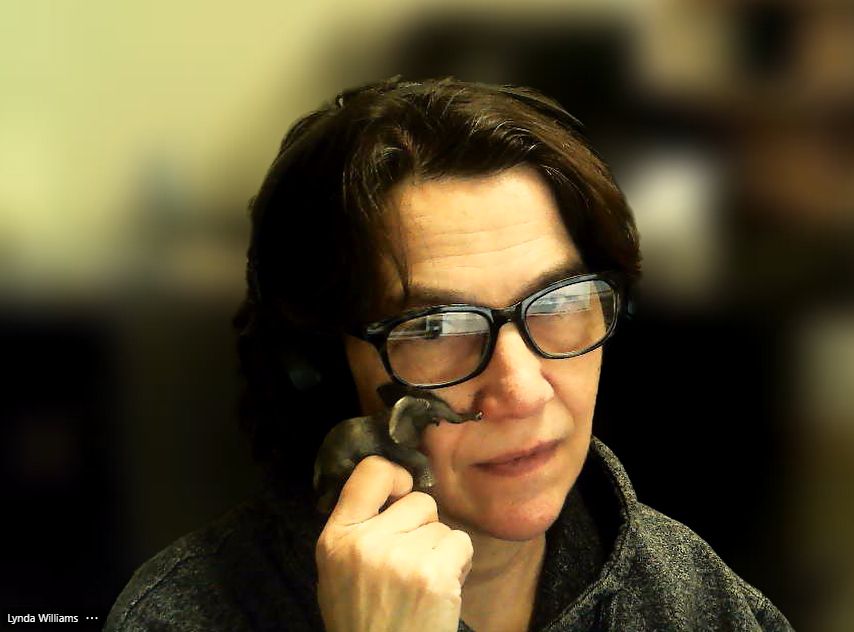
Nina: · How would you define sustainability and what do you consider the key components to be sustained?
Lynda: Human thriving in a context of robust biodiversity. In an SF context, one could place various forms of alien life on the human or the biodiversity side of the equation. The point is, populations continue to evolve, with a view to long-term survival of potential and respect for the value, on multiple fronts, of the potential of future individuals and lifeforms that will arise, in opposition to short term gain for short term goals.
Nina: What does the phrase of our thread title “Sustainability Before Ambition” mean to you and how does it affect you: how you live, what you write?
Lynda: In life—Growing up with the threat of nuclear oblivion, during the cold war, I strongly believe in the need of the many to constrain the ambitions of the few in a manner that limits the damage any present generation can do. It never made any sense to me whatsoever than a couple of leaders in Washington and Moscow should have the right even to risk the destruction of all life on Earth. We shouldn’t even have that right as a species. At the same time, my self-directed study of fields like history, psychology and religion, made it clear there will always be conflicts, ambitions, winners and losers. The key is to base the social contract on values and the means to defend them, that firmly set long-term sustainability above short-term gain for any individual or faction. To build-in mechanisms whereby those who threaten sustainability must be acted on by others to prevent degrading the carrying capacity of the underlying habitat.
In my work — I constructed two different sustainability societies in the Okal Rel Saga. Sevildom, a neo-feudal oligarchy of ancestral houses, and the Arbiter Administration often referred to as Rire, since Rire is its most influential and Earth-like planet.
Okal Rel occurs in many denominations and variations within Sevildom, but its core belief holds sustainability sacred, since souls can only be reborn into habitats able to support life.
On Rire, the sanctity of sustainability is a humanistic / scientific tenet, enforced by a network of impersonal AI known as arbiters which administer laws and regulations created and amended by human councils who are an equally integral part of the overall system of governance.
Both systems have, either in the present or the past, manifest an Earth-centric bias concerning the value of biodiversity. But there are also examples, from both civilizations, where alien life forms have been valued to at least some degree of accommodation.
Nina: In your community, what do you see as the major barriers and facilitators of sustainable living? What do you think are the major barriers and facilitators for organizations and nations?
Lynda: Short term thinking is the biggest problem. And the lack of a trusted, unifying system able to convince all actors their cooperation will benefit them. Also, while a great deal of progress in the human standard of living comes from competition, systems that allow for competition without risking environmental degradation are challenging to defend in the face of immediate needs or simple greed. Humans can develop systems that work within homogonous communities, with shared values and mutual expectations. But tribalism prevents trust in mutual benefits or harms crossing artificial boundaries of nationality or class. We don’t seem to be able to think big enough, or trust others enough, to overcome the tragedy of the commons on a global scale for long term sustainability.
Nina: Industry and corporations (and governments, including our own) use the phrase “sustainable development.” What are your thoughts on that term? Do you think it is a useful term or not?
Lynda: I think it is a useful term until and unless a better one comes along. At least it acknowledges sustainability as a goal. Things like wildlife trees, biodiversity, and even recreational use of nature are built into the system as values. Of course, the truth on the ground is backsliding from even its original highwater mark, and there is always so much lost that I, personally, would rather see saved. But there is no ignoring the economic part of the equation with respect to the use of natural resources. The struggle to accommodate sustainability may lose more battles than it wins, but it wins some. That isn’t true everywhere. I’d rather see governments use phrases like sustainable development than default to profitable exploitation as the right way to phrase it. My great hope is that we learn how to be profitable through sustainability, one day. Progressive Planet (n.d.) is one of my favorite examples, a Canadian microcap profiting from products that are better for the planet than the ones they replace.
Nina: What is your opinion of the Sustainable Development Goals set out as part of the 2030 Agenda for Sustainable Development by world leaders at a UN Summit in 2015.
Lynda: Sadly, I think we are falling short. And it worries me that nations are decreasingly able or interested in working together in the current geopolitical scrum out there.
Nina: What roles can individuals, corporations and governments play in ensuring sustainable living?
Lynda: Governments, like Canada, can set an example. It needs to be an example that works in both directions: shows some good results for sustainability and is still profitable. Otherwise, it just won’t be taken seriously. Corporations can care. I know some do, at least enough to feature it in their presentations and partner with First Nations groups to find ways both can profit while still preserving wildlife. I’ve heard presentations by miners talking very seriously, for example, about periods when they have to shutdown because a herd of caribou is expected to be migrating through their field of operations. I doubt they would have done that in the 1950s when people like my father, who probably liked being out in the bush, still insisted nature didn’t need any accommodation. I remember him saying, once, “What do we need Zebras for?” when I was earnestly advocating for protection of endangered species in my teens. I was shocked. Maybe growing up in the years of the depression in the 1930s does that to you. All you have scope to think about is what you need. We need to make it clear to people they need nature. There is certainly healthy living research leaning that way.
Nina: Speaking of governments and leadership, in a recent post on governance, you mentioned being a fan of enlightened self-interest. What is that, and do you think it plays a role in our pursuit for sustainable living on this planet?
Lynda: Absolutely! For example, I like the fact eco tourism makes more money annually, in BC, than guides taking people out for trophy hunting (Foster, 2026). I believe in enlightened self-interest to motivate people not to destroy valuable things. I have no doubt the diversity of life on our planet is a valuable thing. Nothing last forever. I love Cheetahs but if they do go extinct it will be as much the fault of lions as humans. I donate, occasionally, to helping them. I regularly donate to a couple of causes that promote the long term sustainability of habitat.
Nina: What would you see as important traits or qualities or values in an individual or group to achieve a successful sustainable lifestyle?
Lynda: Mindfulness. Be open to seeing what’s wrong. Perseverance. Don’t get discouraged because it feels too big and impossible a problem. Do what you can and be proud of it. Influence. Be able and willing to share your own practices with conviction and encourage others to do likewise.
Nina: Do you think it is possible to achieve sustainability within a capitalist system? Explain.
Lynda: Yes. There might be systems in which it would work better, but I don’t know if we’ve invented them yet in real life. Maybe I should qualify this answer by saying pro-social capitalist democracies with genuine debate and regulatory oversight on industry can make progress toward sustainability. Pure capitalism, of course, creates an unhealthy wealth imbalance, leaving sustainability at the whim of oligarchs. But kingship and communism run to dictatorship, and then it’s all about the boss staying in power and people lose their voice. There’s a claim out there that communist countries can plan long-term, but I don’t see evidence of this where sustainability is concerned and to the extent any capitalist democracy leans hard in the dictator direction, the same applies. The challenge, for capitalism, is to find a mechanism for valuing the environment in a way that is motivating within the system. Carbon credits were one idea, but I think the jury is out, there. It might be a better emergency measure to take some components of the environment out of the system to be administered differently, such as parks and nature reserves. Indigenous nations with jurisdiction over their territory offer another system for sustainability. It will be interesting to see the models that evolve through industry and Indigenous collaboration on extractive industries.
Nina: Do you think it is possible to achieve sustainability everywhere? If so, why. If not, why. And if the latter case, how should one prioritize?
Lynda: Oxygen. Water. I’d put those first. As they tell you on a pre-flight briefing, should the plane decompress, put on your own oxygen mask before you help others. Humans will fall apart into catastrophic war if we wreck things too badly. I fear the loss of the “lungs of the Earth” – the Amazon, and water riots in cities when Day Zero happens. There’s not much a single person can do, but I donate something every month to a charity that supports sustainable farming in the Amazon (Shaik, 2022). I also give a small monthly donation to a charity I like because it empowers kickass women to protect endangered African animals from poachers, the Akashinga Rangers (Akashinga, n.d.).
Nina: What are the best ways to measure sustainable practices? If you were a governing body how would you do it? And how would you incentivize them?
Lynda: I think I’d work on building an appreciation for the importance of sustainability into school curriculum, to start, and express it in economic terms as well as affective ones. We rely on nature and need to understand this in a practical manner. I’d provide incentive grants to pro-sustainability initiatives in community health, and for industries working to move in a good direction. I like the idea of a carbon credit or something similar where offenders pay and good-actors benefit. It’s pure capitalism. But I’d need to do a study, first, on accusations of green washing and how these might be addressed. A small, targeted study. Doing things that engage public involvement is one thing, but spending too much on producing unactionable reports is another. I’d work towards a service that monitored environmental matters and shared the results live, online, including live wildlife cam streaming video to show people what we’re protecting. I’d also reward industry that does good things. Give them opportunities to get some good press where it is deserved. Maybe create an award or accreditation that’s meaningful.

Nina: Do you feel that authors can play a role in encouraging a sustainable lifestyle? Do any particular writing genres play a more substantial role in establishing a narrative of sustainability?
Lynda: A role, yes. I think fiction should portray important issues in a palatable form where people see some hope and can reach for it without being overwhelmed. Or simply to put the issue on the radar of readers who are reading for pleasure. It must be knitted into the fabric of a good story, though. It can’t preach. Something I learned, being read, is that whatever you intended might not be what your reader sees in your work. But if you present your case believably at least you have put the questions you wanted to explore in play. I think SF can bring the future into a story in a way that gives it an advantage, either in portraying consequences or solutions.
Nina: Can you describe an example from other works or your own work that deal with the concept of sustainability?
Lynda: Anyone who watched The Lord of the Rings movies will relate to the stark contrast between the green world of hobbits and elves, and the blight of war and industrial degradation in the production of Orcs. There’s a lot of this kind of black and white portrayal, in SF, of nature as good and the forces of evil being ugly. Often beautifully done, as in the LOR movies. I think what it lacks is a practical engagement with modern civilization and economic need. Trade offs. Getting to “good enough” rather than perfect, or celebrating a step in the right direction.
Nina: How was sustainability achieved (or not achieved) in the world you created? Was it inspired from a real example?
Earth, in the Okal Rel Saga, is a lost paradise. A sacred place destroyed in the original sin of a space war that severed the connection with the Reach of Earth. Green worlds, those that can support life without artificial habitats, are rare. All habitats are like oasis in the predominantly empty, lifeless wastes of space. Reality skimming ships can cross vast distances in hours but must make dock within the pilot’s tolerance for exposure. Fouling habitat in any way, and especially risking damage to green worlds, is Okal’a’ni. Anti-life. A crime against all for all time. A greater sin than murder. Observed and noted by the souls of the Watching Dead awaiting rebirth, who will punish the guilty when it is their turn to join them by denying them their own chance at rebirth. The separate habitats and worlds of Sevildom rely on each other through various alliances and trade agreements but reality skimming ships are forbidden from engaging in warfare. Or, at least, from damaging habitat or polluting space lanes, because of the original sin. And because safe docks can’t be threatened. What is rare and irreplaceable is valued higher than any single, current incarnation of a life or even many lives. It helps that anyone stigmatized as Okal’a’ni has dropped the shield of honour, which means their wealth and status is forfeit to whatever coalition of avengers can take it, without being constrained by the bounds of alliances and Sword Law. Usually, your own relatives will take you out, fast, to keep titles and possessions in the family.
On Rire’s side of the Okal Rel Universe, the Arbiter Administration values human lives above property, but they, too, have instituted rules to control reality skimming pilots. Their pilots are psych-profiled using sophisticated brain-interfacing technology to ensure they are safe to be allowed to fly. As a scientific culture, Rire places a lot of value on biodiversity, all the more so since only a small subset of Earth-life made it to the Alpha Colonies, from which a succession of systems of governance eventually coalesced into the Arbiter Administration. Rire is a terraformed planet. It is pleasantly Earth-like, with, if anything, a milder more uniform climate. In the early days of its isolation from Earth, which occurred before Sevildom’s, it was unclear the colonists would survive. Native life on Rire was eradicated to establish Earth-life. It was primarily fungus-like, but Rire feels guilty about it, now, nearly a 1,000 years after the purge, and a sense of lost scientific opportunity. The world of Mega, which is extravagantly verdant and swarming with alarming, weird and primative things of an alien origin, is sometimes a challenge to their convictions about preserving all biodiversity. Sadly, they’ve never found any intelligent form of alien life on any of the worlds they settled. (They get very upset, towards the end of the Okal Rel Saga, when they discover Nersallian Sevolites hunt the species they refer to as Grab Rats, for sport, once a linguist realized the Grab Rat that came to the first Cultural Exchange with its Vrellish Sevolite friend, Vras, was holding a conversation with Vras.)
Below is a scene where a child, Horth, speaks for the first time. He’s just witnessed a fatal duel between his father and the uncle, Kene, he hadn’t realized was a challenger until the duel started. Kene had been showing Horth how his people, the Nesaks, made space stations, using a model. The sustainability aspect is the duel itself. Sword Law relies on sharing the Okal Rel belief that it is better one person die (or kill) to settle a conflict than risk space war threatening to habitat. Kene and his father made a deal, and supporters on both side, judging it a fair duel, affirmed the outcome. No war.
Branst bolted. Horth followed. He was weaving through a loose crowd of relatives just as everyone on the Octagon drew their swords and raised them, shouting, “Okal Rel!” in unison, like an earthquake of movement and sound, declaring the matter resolved.
Branst was pounding up the spiral staircase at the back of Black Wedge. Horth caught up. They emerged more or less together in Black Hearth’s reception hall where they had eaten dinner with Kene three days earlier. Branst plunged down the Throat, towards Family Hall.
Horth followed.
Inside the nursery, Branst let out a wild cry — half laugh and half shout — kicking things aside as he crossed the floor. A small, hard ball went flying into Horth and Kene’s nearly finished space station. Pieces flew from it at the point of impact, and the whole structure shook, spoiling half a hundred pain-staking alignments.
Branst froze. He looked at Horth as if he had accidentally killed someone.
Horth knelt down, picked up a piece that had fallen to the floor, and remembered how Kene had showed him where to place it the day before.
“Gee, Horth,” Branst said, chagrined. “I didn’t mean—”
“Ack rel,” Horth said, and set the piece down.
“What?” Branst floundered, astonished.
“Ack rel,” Horth said again, and rose, leaving the broken piece behind him.
They were strong words. The same words Father spoke to Kene. Words that acknowledged the pain in any triumph. Words that promised things could matter, terribly, and not bring the world to an end in one fatal spasm. A promise that life could outlive quarrels, even if they had to be fatal for someone.
“You talked!” Branst said, blinking, and blurted a laugh.
Horth frowned. He wanted to share all he felt, but he didn’t know how.
Zrenyl came in behind them and Branst turned to him excitedly. “He spoke,” Branst told Zrenyl.
“Horth said something.”
“He did?” the older boy asked, in a daze.
“Say it again, Horth!” Branst insisted.
But to say it again might make it feel less important, somehow. Horth walked towards the damaged model space station. Silently, he began exploring the wound where the ball had struck.
Glossary
Okal'a'ni: that which is anti-life, beyond the acceptable limits of striving to gain what you desire. Okal Rel sacrilege involving the destruction of habitat where life can thrive. It is the duty of the righteous to punish and destroy those who transgress so that all see and know they can't achieve a selfishly benefit from committing an okal'a'ni act. You can confiscate their property, too, which is motivating.
Rel: most commonly equated with superior, strong, decisive, and assertive action in pursuit of one’s desires.
Okal Rel: The ‘way of moral conflict’ tolerant of lethal force in the pursuit of goals so long as the carrying capacity of the environment is held sacred and habitat is not destroyed.
Ack Rel: an expression to imply that, “struggle though we may, things will fall out as luck and skill dictate.” Translates to: “get over it” or “tough break” in one respect, but most importantly it is underpinned by the implicit contract that the conflict will be limited to stakes that do not threaten habitat and the ability of life to go on. Sustainability, in other words.
---------------
Lynda Williams (born February 17, 1958, in Prince George, British Columbia) is a Canadian speculative fiction author best known for the Okal Rel Saga, a ten‑novel space‑opera series exploring cultural conflict, bio‑engineering, and interstellar civilizations. Her work, developed over decades, has been published by Windstorm Creative/Fandom Press, Circlet Press, Future Fire, Scroll in Space, Edge Science Fiction and Fantasy Publishing/Absolute XPress and later through Reality Skimming Press. Alongside her writing, Williams has built a significant career in educational technology, teaching applied computing at the University of Northern British Columbia and later serving as a Learning Technology Analyst and Manager at Simon Fraser University. She also founded the online journal Reflections on Water and has contributed to instructional design and digital learning initiatives.
Lynda Williams on LinkedIn. https://www.linkedin.com/in/lyndajwilliams/
Google Search for Lynda Williams, author, Okal Rel. SEARCH LINK
Reality Skimming on Facebook. https://www.facebook.com/relskim
---------------
Nina Munteanu is an Canadian ecologist, author, editor and writing coach, notably but not exclusively in the realm of Speculative Fiction (SF/F). In addition to nine published novels, Munteanu has written short stories, articles and non-fiction books, which have been translated into several languages throughout the world. Munteanu is a member of SF Canada.
Nina Munteanu on LinkedIn. https://www.linkedin.com/in/ninamunteanu/
Nina Munteanu Writing Coach. https://ninamunteanu.me/
Nina Munteanu (Wikipedia). https://en.wikipedia.org/wiki/Nina_Munteanu
---------------
Image Credits
Milburn, M. (2025). Cover art for Okal Rel Saga Book 3: Righteous Anger.
Williams, L. (2026). Screenshot of author posing with an elephant from her collection.

kèo nhà cái 55 mình thấy mọi người nhắc hoài nên cũng tò mò bấm vào xem thử giao diện thế nào. Mình không có ngồi soi từng mục hay nội dung cụ thể đâu, chỉ lướt qua kiểu bố cục và cách họ sắp xếp thông tin cho dễ nhìn. Ấn tượng đầu là trang chia khu vực theo nhóm khá rõ, nhìn dạng khối nên kéo xuống không bị loạn mắt. Mấy bảng thông tin hiển thị theo cột gọn gàng, liếc nhanh là nắm được ý chính chứ không phải đọc mỏi. Menu cũng đặt chỗ dễ thấy nên chuyển qua lại giữa các phần khá mượt, không phải bấm tìm vòng vòng. Nói chung lướt vài…
Bài viết dễ đọc và có nhiều chi tiết hay, cảm ơn bạn đã chia sẻ. Bạn mình gửi link bài này nên mình vào xem, đoạn bạn tả cảm giác nghe nhạc số và nâng DAC thấy khá thuyết phục. Mình thì ngày nào cũng theo dõi thống kê XSMB nên tự gom lại thành một trang để tiện tra nhanh. Ai cần số liệu cập nhật theo ngày thì xem ở đây https://soicauxsmbpro.themedia.jp/pages/9916215/page_202608030027